Introduction: The Hidden Cost of Design Conflicts in EPC
In the world of EPC (Engineering, Procurement, and Construction), even a minor design clash can escalate into a multi-million-dollar problem. From piping overlaps to structural misalignments, traditional clash detection methods often identify issues too late—during construction or fabrication.
At iSolve Engineering Technology, we believe design errors should never reach the site.
With the rise of AI Clash Detection, EPC organizations now have the power to move from reactive problem-solving to predictive design intelligence. By embedding AI into BIM and 3D plant engineering workflows, clashes are not just detected—they are anticipated and prevented before they occur.
What is AI-Powered Clash Detection?
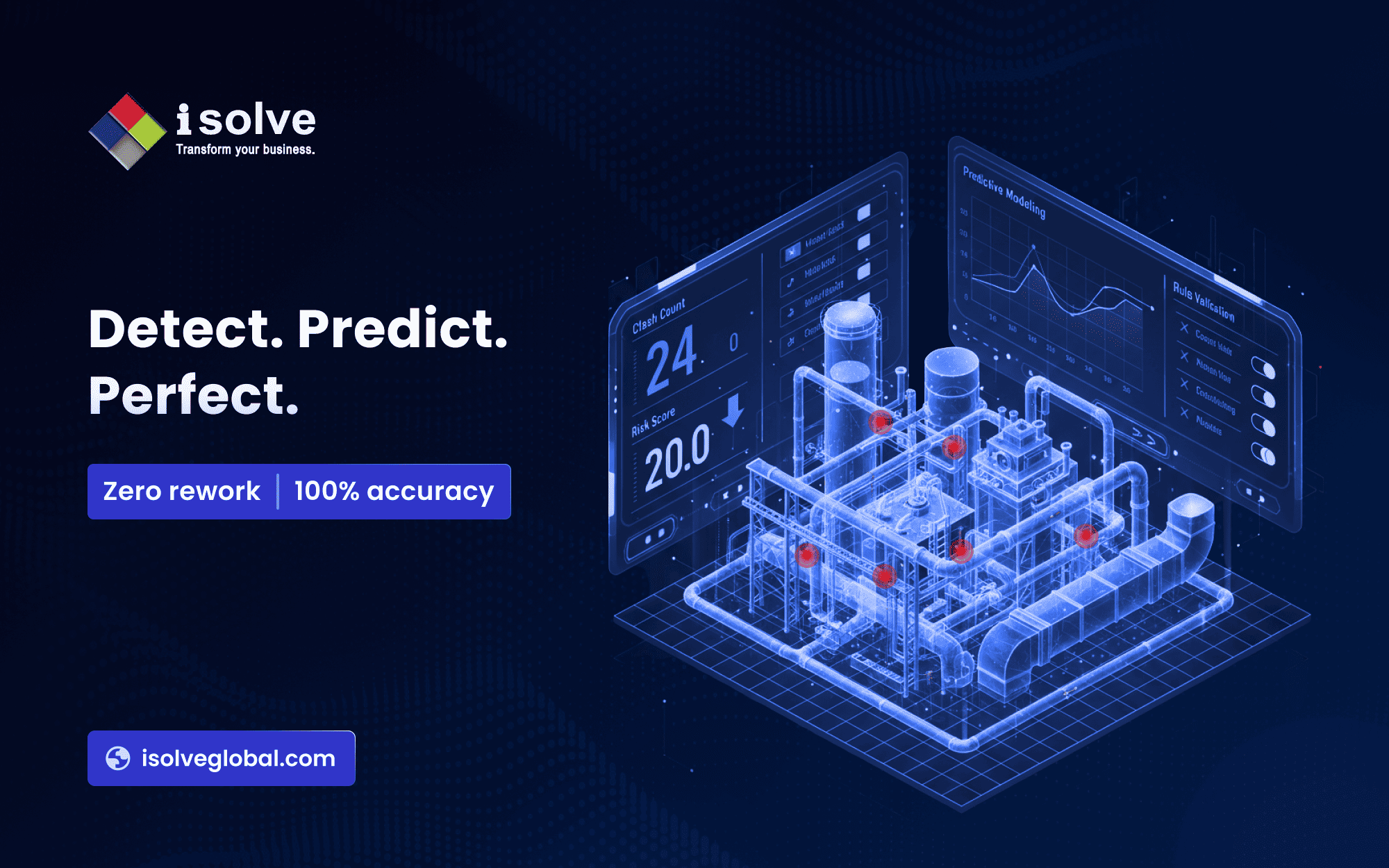
AI-powered clash detection goes beyond rule-based checks. It leverages machine learning, predictive modeling, and real-time data analysis to identify potential conflicts even before they are geometrically visible.
Unlike conventional tools that flag clashes after model creation, AI systems:
- Learn from historical project data
- Predict high-risk design zones
- Automate design rule validation
- Continuously monitor model changes in real-time
This shift enables proactive decision-making, ensuring superior EPC Design Accuracy across all project stages.
The Evolution: From Detection to Prediction
Traditional clash detection tools answer:
👉 “Where are the clashes?”
AI-powered systems answer:
👉 “Where will clashes occur—and how do we prevent them?”
This evolution is powered by Predictive Modeling, which analyzes patterns across:
- Design templates
- Engineering standards
- Past project conflicts
- Multi-disciplinary dependencies
The result? A system that doesn’t just detect errors—it thinks like an experienced engineer.
Key Capabilities Driving AI Clash Detection
1. Predictive Clash Resolution
AI models analyze design intent and historical conflicts to identify future clash probabilities.
- Flags high-risk zones before modeling completion
- Suggests alternative routing or layouts
- Reduces dependency on manual coordination
This ensures that clashes are resolved at the design stage—not during execution.
2. Real-Time Validation Across Disciplines
In EPC projects, multiple teams work simultaneously—civil, structural, piping, electrical, and instrumentation.
AI-powered platforms enable:
- Continuous clash monitoring during design updates
- Instant validation across disciplines
- Real-time alerts for conflicting changes
With iSolve’s smart BIM ecosystem, teams collaborate on a single source of truth, ensuring zero coordination gaps.
3. Design Rule Automation
Manual rule-checking is time-consuming and prone to oversight. AI automates this by:
- Embedding engineering standards into workflows
- Validating compliance dynamically
- Auto-correcting design inconsistencies
This eliminates repetitive tasks and ensures consistent engineering quality at scale.
How AI Prevents Rework in EPC Projects
Rework is one of the biggest cost drivers in EPC projects—often accounting for 10–30% of total project costs.
AI-powered clash detection reduces rework by:
- Identifying issues in early design phases
- Preventing downstream fabrication errors
- Minimizing site-level modifications
- Enhancing coordination between stakeholders
With iSolve’s AI-driven approach, organizations can achieve:
- Faster project delivery
- Reduced cost overruns
- Improved safety and compliance
- Higher client satisfaction
iSolve’s Approach: Intelligent Engineering with AI
At iSolve Engineering Technology, we integrate AI seamlessly into engineering workflows through:
Smart BIM Solutions
Enabling intelligent model coordination with real-time validation and AI-assisted design insights.
AI-Driven 3D Plant Engineering
Automating design processes with predictive intelligence to eliminate clashes before they occur.
iBIM Level Management
Ensuring structured, standardized, and clash-free design progression across all project stages.
Smart Schedule Builder
Aligning design workflows with project timelines to ensure clash resolution does not delay execution.
Our solutions are designed to empower EPC companies with data-driven engineering intelligence, transforming how projects are designed, validated, and delivered.
Future of EPC Design: Autonomous Engineering Systems
AI-powered clash detection is just the beginning.
The future lies in autonomous engineering systems where:
- Designs self-optimize in real-time
- Systems auto-correct based on predictive insights
- Human intervention is focused on innovation—not error correction
EPC organizations that adopt AI today will lead tomorrow with:
- Faster project cycles
- Zero-error engineering
- Scalable digital transformation
Conclusion: From Reactive to Predictive Engineering
Design clashes are no longer inevitable—they are preventable.
With AI Clash Detection, EPC companies can shift from reactive troubleshooting to predictive engineering excellence. By leveraging Predictive Modeling and intelligent automation, organizations can achieve unmatched EPC Design Accuracy, eliminate rework, and accelerate project delivery.
At iSolve Engineering Technology, we are not just solving engineering problems—we are redefining how engineering is done.


