The Future of Industrial Plant Design Is Not Just Automated—It Is Predictive
In a complex industrial plant or EPC project, rework rarely begins on the construction site.
It often begins much earlier.
A pipe route is modeled without considering a future structural constraint. An equipment layout changes after downstream disciplines have already progressed. A support is moved, but related elements require manual adjustments. A model contains a clash that remains hidden until a coordination review—or worse, until fabrication or installation.
For Engineering, Procurement and Construction teams, these are not isolated modeling issues. They create a chain reaction across engineering hours, material quantities, schedules, procurement, fabrication and project delivery.
This is why the next evolution of BIM is moving beyond model creation toward model intelligence.
With Industrial BIM AI, engineering teams can begin using design data, engineering rules, model relationships and predictive analysis to identify risks earlier and automate repetitive decisions. Combined with EPC Design Automation, AI has the potential to transform plant design from a reactive workflow—where teams detect and fix problems after they occur—into a predictive workflow that helps prevent them before they become expensive.
At iSolve Engineering Technologies, this is the direction we are building toward: combining AI-powered BIM, 3D plant engineering, rule-based workflows, intelligent model management and schedule automation to help engineering teams design faster, coordinate better and reduce unnecessary rework.
The objective is simple:
Don’t wait for design conflicts to become project problems. Predict them early and engineer around them.
Why Rework Remains One of the Biggest Challenges in EPC Design
Industrial plants are fundamentally different from simple building projects.
A process plant can involve interconnected systems across:
- Process engineering
- Piping
- Mechanical equipment
- Civil and structural engineering
- Electrical systems
- Instrumentation
- HVAC and utilities
- Pipe supports
- Construction planning
- Procurement and fabrication
Every discipline contributes information to the same physical environment.
The challenge is that these decisions are rarely independent.
A small modification in equipment location can affect pipe routing. A change in piping elevation can affect structural supports. A level correction can influence hosted elements, documentation and downstream coordination. A revised quantity can impact BOQ, cost planning and procurement.
Traditional BIM and 3D modeling platforms provide powerful visualization and coordination capabilities. However, engineering teams can still spend significant time on manual checking, repetitive model updates, rule verification and issue resolution.
This is where Industrial BIM AI introduces a new possibility.
Instead of simply asking:
“What clashes exist in the model?”
Predictive engineering can begin asking:
“What design decisions are likely to create conflicts, delays or rework next?”
That distinction is critical.
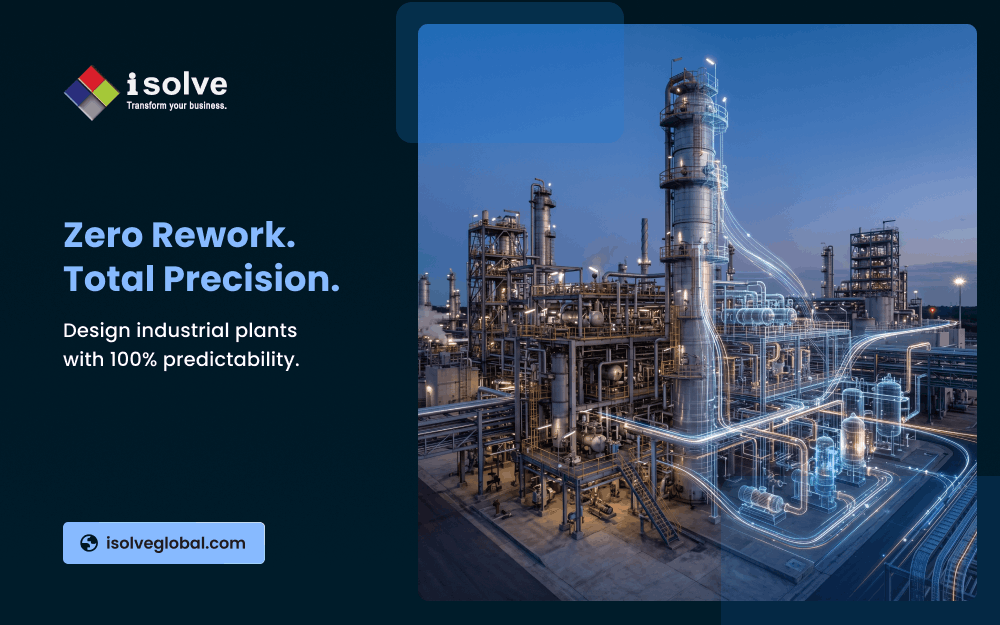
What Is Industrial BIM AI?
Industrial BIM AI is the application of artificial intelligence, machine learning, engineering rules and intelligent automation to industrial BIM and plant design workflows.
Rather than treating a 3D model as a static representation of the plant, AI-enabled BIM can help transform it into a connected source of engineering intelligence.
Depending on the workflow and available data, this can support:
- Intelligent piping layout analysis
- Automated model validation
- Predictive clash identification
- Design rule verification
- Parametric modeling
- Pattern recognition across engineering data
- Automated quantity and schedule workflows
- Context-aware engineering assistance
- Intelligent level and element management
- Real-time model monitoring
- Digital twin integration
The key is not replacing engineering expertise.
The real value comes from allowing engineers to spend less time searching for problems and more time solving high-value engineering challenges.
iSolve’s Smart BIM Solutions are designed around this direction, combining AI-powered automation, parametric modeling, multi-discipline coordination, cost intelligence and digital engineering workflows for AEC and EPC environments.
From Reactive Clash Detection to Predictive Clash Prevention
Traditional clash detection is essential. But in many workflows, clash detection happens after multiple disciplines have already created and coordinated significant amounts of model content.
The team then enters the familiar cycle:
Detect → Review → Assign → Modify → Recheck → Repeat
AI can help shift this workflow toward earlier intervention.
A predictive BIM workflow can analyze model relationships, design patterns, spatial constraints and engineering rules to identify areas with a higher probability of future conflicts.
For example, an intelligent system may help identify:
- Congested piping corridors
- Potential clearance violations
- Equipment maintenance access risks
- Pipe-to-structure conflicts
- Support placement inconsistencies
- Repeated design errors
- Non-standard routing patterns
- Elements likely to create downstream coordination issues
The goal is not simply to generate more clash reports.
The goal is to generate better engineering decisions.
iSolve’s engineering approach already focuses on clash-free multi-discipline collaboration, integrated 3D plant workflows and automated engineering processes. Its AI-driven engineering content also describes workflows where potential clashes can be identified in real time, prioritized and evaluated before they become late-stage redesign issues.
AI for Smarter Piping Layouts
Piping is one of the most complex and data-intensive areas of industrial plant design.
Engineers must balance numerous requirements, including:
- Process requirements
- Pipe specifications
- Equipment connectivity
- Pressure and flow considerations
- Structural constraints
- Accessibility
- Maintenance clearance
- Safety requirements
- Pipe support locations
- Material efficiency
- Fabrication requirements
Traditionally, optimizing these decisions can involve multiple iterations between disciplines.
With EPC Design Automation, repetitive engineering logic can increasingly be embedded into digital workflows.
Imagine an engineering environment where a designer can query the model to:
- Identify pipelines exceeding defined operating parameters
- Highlight congested corridors
- Review potential conflict zones
- Explore optimized routing alternatives
- Generate equipment or pipe schedules
- Validate clearances against engineering rules
iSolve’s work around NLP-powered engineering explores this direction further, demonstrating how natural-language interactions can be connected with plant and BIM data to support tasks such as identifying compatible equipment, validating spatial constraints, applying maintenance envelopes and highlighting engineering issues.
The future of plant design may therefore become increasingly conversational, context-aware and engineering-rule driven.
An engineer should not need to manually search through thousands of model elements to answer every design question.
The model itself should become easier to interrogate.
Zero Rework Starts with Better Model Intelligence
“Zero rework” should not be interpreted as a promise that engineering projects will never require design changes.
Complex EPC projects will always evolve.
Instead, zero-rework engineering should be viewed as a strategic goal: eliminating avoidable rework caused by disconnected data, repetitive manual tasks, inconsistent standards and late discovery of design issues.
This requires stronger control over model intelligence.
Consider level management.
In a multi-discipline BIM project, changing element levels manually can create unintended consequences involving positions, hosted elements, constraints and related documentation.
iSolve’s iBIM Level Management addresses this challenge through guided, rule-based workflows that preserve world-space positions, support category-aware operations, provide safeguards and enable bulk alignment across disciplines. This helps reduce manual post-move corrections and prepares models for coordination, clash detection and downstream documentation.
This is an important example of the broader future of EPC Design Automation.
AI does not always need to “design everything.”
Often, its greatest value lies in embedding intelligence and guardrails into high-frequency engineering activities where manual mistakes are most likely to occur.
Real-Time Engineering Monitoring: From Model Snapshot to Continuous Intelligence
Traditional engineering workflows often rely on periodic reviews.
A model is developed.
A coordination meeting is scheduled.
Issues are identified.
Changes are assigned.
The process repeats.
The next generation of Industrial BIM AI can move closer to continuous engineering intelligence.
Instead of treating the model as something reviewed only at defined milestones, teams can work toward real-time monitoring of:
- Model changes
- Rule violations
- Design conflicts
- Quantity changes
- Schedule impacts
- Discipline coordination issues
- Compliance deviations
- Data completeness
This concept becomes even more powerful when connected to digital twins.
A well-structured BIM environment can serve as a foundation for lifecycle intelligence, connecting engineering information with operational, maintenance and asset data. iSolve’s Smart BIM and digital engineering direction emphasizes metadata-rich models, digital twin integration and connected workflows across design, construction and plant lifecycle management.
The result is a significant shift in mindset:
The engineering model is no longer just a deliverable. It becomes an intelligent operational asset.
Connecting Predictive Engineering with Smart Scheduling
Design intelligence becomes more valuable when its impact can be understood beyond geometry.
A design change can affect quantities.
Quantities can affect procurement.
Procurement can affect construction schedules.
This is where EPC Design Automation must connect model intelligence with project intelligence.
iSolve’s Smart Schedule Builder connects live Revit data with structured Excel inputs to help standardize classification, automate quantity takeoffs, provide model-linked verification and generate structured, discipline-ready outputs. Its workflow is designed to reduce manual mapping and improve traceability between model elements and reporting.
In a more advanced predictive environment, this type of connected data can support questions such as:
- What happens to quantities if this design package changes?
- Which areas of the model require verification?
- Which discipline changes may affect downstream deliverables?
- Where are inconsistencies emerging?
- Which activities could face delays because of unresolved engineering issues?
This is where BIM evolves from visual coordination into predictive project intelligence.
The iSolve Engineering Technologies Approach to Predictive EPC Workflows
At iSolve Engineering Technologies, our technology direction is centered on helping AEC and EPC organizations simplify complex engineering workflows through intelligent automation.
Our ecosystem brings together capabilities across:
1. Smart BIM Solutions
AI-powered design automation, parametric workflows, multi-discipline coordination, cost intelligence and digital engineering.
2. 3D Plant Engineering
Integrated workflows for complex piping, equipment, supports and plant engineering, with digital catalogs, automated engineering processes and clash-focused coordination.
3. iBIM Level Management
Guided, rule-based level reassignment that preserves spatial accuracy and reduces manual corrections across multi-discipline BIM environments.
4. Smart Schedule Builder
Model-linked quantity, classification and schedule automation designed to improve verification, consistency and reporting efficiency.
Together, these capabilities support a larger vision:
Create engineering workflows where intelligence is embedded directly into the way models are created, validated, coordinated and delivered.
The Future of Industrial BIM AI: Engineering Before Problems Exist
The next generation of plant engineering software will not simply provide engineers with more tools.
It will provide them with more context.
AI-powered BIM environments will increasingly be capable of recognizing patterns, evaluating constraints, monitoring model changes and helping engineering teams identify potential problems before those problems propagate across the project.
The future workflow may look like this:
Design → Analyze → Predict → Validate → Automate → Optimize
Instead of waiting until the coordination stage to discover an issue, the system can increasingly help engineers identify risks while decisions are still inexpensive to change.
For EPC organizations, this creates the potential for:
- Faster design cycles
- Improved piping and layout coordination
- Earlier clash prevention
- Reduced repetitive engineering work
- Better quantity accuracy
- More consistent engineering standards
- Stronger multi-discipline collaboration
- Improved schedule visibility
- Reduced avoidable rework
The ultimate objective is not to automate engineering blindly.
It is to create human-led, AI-augmented engineering workflows where technology handles repetitive analysis and validation while engineers retain control over critical technical decisions.
Conclusion: The Path to Zero Rework Begins with Predictive Engineering
Industrial plants are becoming more complex. Project timelines are becoming tighter. Engineering teams are expected to deliver greater accuracy without increasing coordination cycles.
Traditional design automation is no longer enough.
The future belongs to predictive engineering—where BIM models do more than represent what has been designed. They help teams understand what could go wrong next.
With Industrial BIM AI and EPC Design Automation, the opportunity is to transform industrial plant engineering from a workflow built around detecting errors into one increasingly focused on preventing them.
At iSolve Engineering Technologies, we are building toward that future by connecting Smart BIM, 3D plant engineering, intelligent model management, automated schedules and AI-driven engineering workflows into a more connected digital ecosystem.
Because the future of EPC is not simply about designing faster.
It is about predicting better, coordinating earlier and reducing rework before it begins.
Ready to Build More Intelligent EPC Workflows?
If your organization is looking to modernize plant engineering, BIM coordination or design automation workflows, explore how iSolve Engineering Technologies can help connect AI-powered BIM, 3D plant engineering and intelligent automation into your engineering ecosystem.
From complex models to predictive engineering—build smarter with iSolve.


