How Predictive BIM and AI Clash Detection Are Transforming Construction Coordination
The construction industry is entering a new era where Building Information Modeling (BIM) is no longer just about 3D visualization—it is becoming intelligent, predictive, and autonomous. Traditional clash detection methods helped project teams identify design conflicts before construction began, but modern projects demand something far more advanced.
Today, Artificial Intelligence (AI) is revolutionizing clash detection in BIM by enabling predictive analysis, automated issue prioritization, deep-learning-based conflict recognition, and real-time design intelligence.
At iSolve Engineering Technologies, we believe the future of BIM lies in AI-powered digital engineering ecosystems that minimize rework, accelerate coordination, improve constructability, and reduce project risks long before construction begins.
From complex industrial plants and smart infrastructure to high-rise commercial buildings and MEP-intensive facilities, AI-driven clash detection is helping engineering and construction teams move from reactive coordination to predictive BIM intelligence.
In this blog, we explore the five biggest ways AI is transforming clash detection and why forward-thinking organizations are adopting predictive BIM workflows to stay ahead.
Why Traditional Clash Detection is No Longer Enough
Conventional clash detection tools operate primarily on rule-based systems. They identify geometric overlaps between structural, architectural, and MEP elements inside BIM environments.
While effective, traditional workflows often create several challenges:
- Thousands of irrelevant clash reports
- Time-consuming manual review processes
- Difficulty prioritizing critical issues
- Poor coordination across multidisciplinary teams
- Limited predictive capabilities
- High dependency on human interpretation
- Increased project delays and rework risks
As BIM models become larger and more data-intensive, traditional clash detection methods struggle to keep up with project complexity.
This is where AI-powered clash detection changes everything.
AI enables BIM systems to learn from historical project data, identify patterns, predict future coordination risks, and automate intelligent decision-making across the project lifecycle.
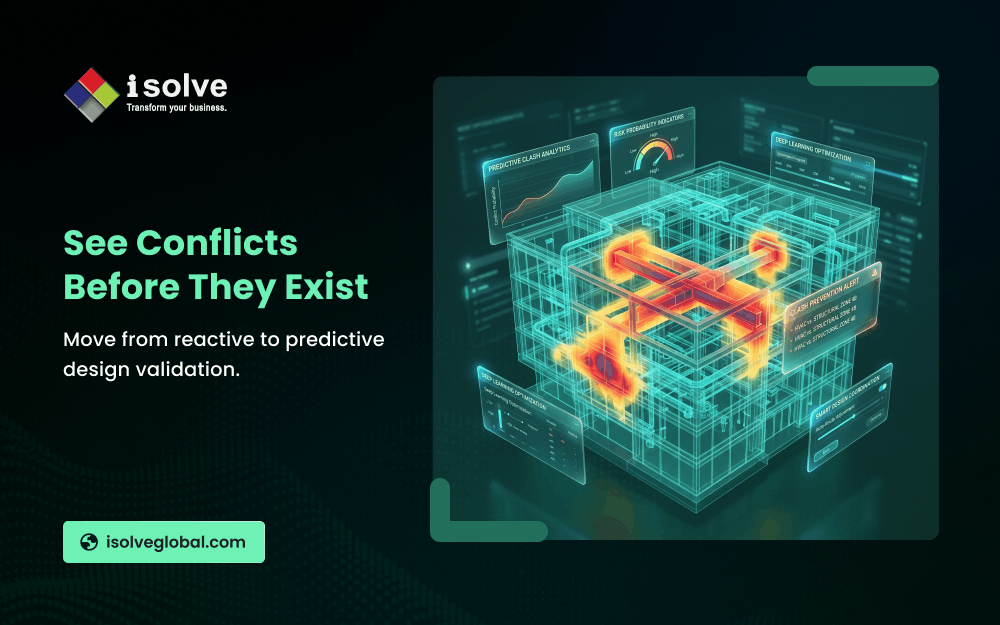
1. AI Enables Predictive Clash Detection Instead of Reactive Detection
One of the biggest breakthroughs in modern BIM workflows is predictive clash detection.
Traditional BIM coordination identifies clashes after they occur inside the model. AI-powered systems, however, can predict high-risk conflict zones before detailed modeling is completed.
Using machine learning algorithms and historical project intelligence, AI can analyze:
- Previous project coordination patterns
- Common MEP routing conflicts
- Structural interference trends
- Constructability constraints
- Space optimization issues
- Discipline-specific coordination behaviors
This predictive intelligence allows project teams to proactively redesign layouts before clashes become expensive field issues.
For example, in large industrial plants or commercial towers, AI can forecast likely HVAC-routing conflicts in congested ceiling zones based on historical coordination datasets.
This significantly reduces:
- Rework costs
- RFIs (Requests for Information)
- Construction delays
- Site coordination conflicts
- Material wastage
At iSolve Engineering Technologies, our intelligent BIM coordination methodologies help engineering teams shift from reactive issue management to proactive digital construction planning.
2. Deep Learning Improves Clash Prioritization and Accuracy
Traditional clash detection often generates thousands of clashes—many of which are false positives or low-priority issues.
This creates “clash fatigue” among BIM coordinators and project managers.
AI-powered deep learning systems solve this challenge by intelligently classifying and prioritizing clashes based on:
- Severity
- Constructability impact
- Installation sequence
- Safety implications
- Cost impact
- Schedule impact
- Discipline dependencies
Instead of reviewing thousands of irrelevant clashes manually, teams can focus only on high-priority actionable conflicts.
AI models continuously learn from project decisions and coordination outcomes, becoming smarter over time.
For example:
A pipe crossing a maintenance access zone may be identified by AI as a critical operational clash—even if there is no direct geometric collision.
This level of contextual intelligence is impossible with conventional rule-based systems alone.
Deep learning also improves detection accuracy in complex BIM environments involving:
- Industrial process plants
- Oil & gas facilities
- Manufacturing units
- Data centers
- Hospitals
- Airports
- Smart infrastructure projects
By integrating AI into BIM coordination workflows, organizations gain faster decision-making capabilities and significantly improved model quality.
3. AI Automates Clash Resolution Recommendations
The next evolution of BIM is not just detecting clashes—but automatically recommending solutions.
Modern AI-powered BIM platforms can now suggest intelligent rerouting options and design alternatives based on:
- Spatial constraints
- Discipline priorities
- Engineering standards
- Constructability logic
- Previous project resolutions
- Installation feasibility
For instance, if HVAC ducts interfere with structural beams, AI can automatically suggest:
- Alternate routing paths
- Optimized elevation adjustments
- Rerouting sequences
- Space utilization improvements
This dramatically reduces coordination time between architects, structural engineers, MEP consultants, and contractors.
At iSolve Engineering Technologies, our Smart BIM solutions focus on creating digitally coordinated environments that accelerate collaboration and reduce engineering bottlenecks across complex projects.
AI-driven resolution intelligence also helps reduce dependency on repetitive manual coordination meetings, enabling faster project delivery.
4. AI Improves Real-Time Collaboration Across BIM Teams
Modern construction projects involve multiple stakeholders working across different locations, disciplines, and software ecosystems.
AI-powered BIM coordination introduces real-time collaborative intelligence that enhances communication between teams.
Instead of static clash reports, AI systems can now provide:
- Live clash alerts
- Intelligent notifications
- Real-time model health analysis
- Automated coordination dashboards
- Predictive risk scoring
- Dynamic issue tracking
This creates a connected BIM environment where teams can resolve conflicts earlier and collaborate more effectively.
AI also helps unify data from:
- Architectural models
- Structural models
- MEP systems
- Fabrication models
- Construction sequencing platforms
- Facility management databases
The result is a centralized digital engineering ecosystem with greater transparency and faster coordination cycles.
For globally distributed engineering projects, this real-time intelligence becomes essential for maintaining project accuracy and delivery timelines.
5. AI Drives Smarter Digital Twin and Lifecycle BIM Strategies
AI-driven clash detection is not limited to preconstruction coordination.
It plays a major role in enabling Digital Twin ecosystems and lifecycle BIM management.
As BIM evolves into operational intelligence platforms, AI continuously analyzes asset performance, maintenance access, operational constraints, and future retrofit requirements.
This enables predictive coordination not just during design—but throughout the building lifecycle.
For example, AI can identify future maintenance clashes inside operational facilities before equipment replacement occurs.
This is especially valuable for:
- Smart factories
- Industrial plants
- Healthcare facilities
- Airports
- Energy infrastructure
- Mission-critical buildings
At iSolve Engineering Technologies, our advanced BIM and digital engineering services are aligned with next-generation Digital Twin strategies that support intelligent asset lifecycle management.
AI-powered predictive BIM is becoming the foundation of future-ready infrastructure.
AI vs Traditional Rule-Based Clash Detection
| Feature | Traditional Clash Detection | AI-Powered Clash Detection |
|---|---|---|
| Detection Method | Rule-based | Predictive & intelligent |
| Clash Prioritization | Manual | Automated |
| False Positives | High | Reduced |
| Predictive Intelligence | Limited | Advanced |
| Coordination Speed | Slower | Faster |
| Resolution Suggestions | Manual | AI-assisted |
| Learning Capability | None | Continuous learning |
| Lifecycle Integration | Minimal | Extensive |
The transition from rule-based BIM coordination to AI-driven predictive BIM is redefining how projects are planned, coordinated, and executed.
The Future of AI Clash Detection in BIM
The future of BIM coordination will be increasingly autonomous.
Emerging AI capabilities will soon include:
- Autonomous clash resolution
- Natural language BIM coordination
- AI-driven construction simulation
- Generative design optimization
- Predictive scheduling intelligence
- Real-time site-to-model synchronization
- Intelligent constructability validation
As projects become more complex and schedule-sensitive, organizations adopting AI-powered BIM workflows will gain major competitive advantages in productivity, cost optimization, and project delivery efficiency.
Why iSolve Engineering Technologies Is Future-Ready
At iSolve Engineering Technologies, we combine advanced BIM expertise, AI-driven engineering intelligence, smart coordination workflows, and digital transformation capabilities to help organizations modernize their project delivery ecosystems.
Our capabilities include:
- Smart BIM Solutions
- Intelligent Clash Detection
- Predictive BIM Workflows
- Digital Twin Enablement
- BIM Level Management
- 3D Plant Engineering
- Smart Schedule Integration
- Engineering Data Coordination
- AI-Enhanced Project Intelligence
We help engineering, construction, EPC, manufacturing, and infrastructure companies achieve faster project execution with reduced coordination risks and improved digital collaboration.
Conclusion
AI is no longer an experimental technology in BIM—it is becoming the core engine behind next-generation digital engineering.
From predictive clash detection and intelligent coordination to automated resolution recommendations and Digital Twin integration, AI is fundamentally transforming how BIM projects are executed.
Organizations that continue relying solely on traditional rule-based coordination workflows risk falling behind in an increasingly intelligent construction ecosystem.
The future belongs to predictive BIM.
And that future has already begun.
If your organization is looking to modernize BIM coordination with AI-driven intelligence, iSolve Engineering Technologies can help you build scalable, future-ready digital engineering workflows designed for smarter project delivery.


