How Digital Twins Unlock Continuous Value Beyond Construction
Construction may end, but asset performance begins the moment a facility becomes operational. Many organizations still treat Building Information Modeling (BIM) as a project delivery tool used only for design coordination and handover. That approach leaves significant long-term value untapped.
At iSolve Engineering Technology, we help organizations transform BIM data into intelligent operational ecosystems through Digital Twin BIM strategies that continue delivering measurable value long after construction is complete.
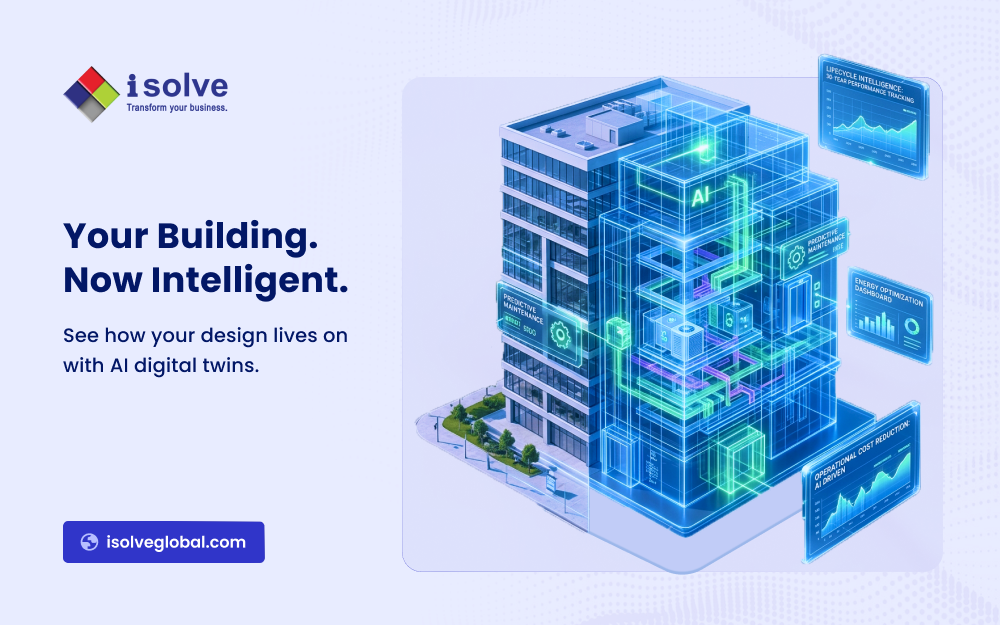
A digital twin is more than a 3D model. It is a live, data-connected replica of a physical asset that continuously receives information from systems, sensors, teams, and workflows. When integrated with AI, IoT, and enterprise platforms, it becomes a decision engine for maintenance, sustainability, safety, and lifecycle planning.
If your building, plant, campus, or infrastructure asset is still operating with disconnected spreadsheets, reactive maintenance, and siloed systems, the future is already calling.
What Is Digital Twin BIM?
Digital Twin BIM combines structured BIM data with real-time operational intelligence. Instead of static drawings or archived models, organizations gain a dynamic digital environment where every asset component can be monitored, analyzed, and optimized.
This includes:
- Mechanical, electrical, and plumbing asset visibility
- Equipment performance tracking
- Space utilization analytics
- Energy consumption monitoring
- Predictive service scheduling
- Lifecycle replacement planning
- Safety and compliance reporting
With the right implementation, BIM evolves from project documentation into an operational intelligence platform.
Why Continuous Value Matters After Construction
Industry studies consistently show that the majority of an asset’s total cost occurs after construction through operations, maintenance, repairs, utilities, upgrades, and downtime.
That means the real ROI opportunity is not only in building faster—it is in operating smarter.
Organizations that adopt BIM Lifecycle strategies can reduce inefficiencies across decades of asset ownership by enabling:
- Faster issue resolution
- Lower unplanned downtime
- Better maintenance planning
- Improved energy efficiency
- Higher occupant satisfaction
- Smarter capital expenditure decisions
This is where digital twins create continuous business value.
1. Lifecycle Visibility Across Every Asset
Most facilities struggle because critical data lives in separate systems—drawings in one folder, maintenance records in another, vendor manuals elsewhere, and live performance data in yet another platform.
Digital twins unify these layers into one connected environment.
With a lifecycle-ready twin, teams can instantly view:
- Asset location in 3D context
- Installation date and warranty status
- Maintenance history
- Current operating condition
- Replacement cost forecasts
- Linked manuals and documents
Instead of searching across systems, teams work from a single source of truth.
At iSolve Engineering Technology, our smart BIM solutions help organizations structure asset intelligence from day one—making long-term operations more efficient.
2. AI Maintenance Replaces Reactive Maintenance
Traditional maintenance often starts after failure. That means emergency repairs, production delays, tenant complaints, or safety risks.
With AI Maintenance, digital twins analyze trends from equipment data such as vibration, runtime, temperature, pressure, or energy draw. AI models detect anomalies before breakdowns occur.
Benefits include:
- Predicting equipment failures early
- Reducing emergency callouts
- Extending asset life
- Optimizing technician schedules
- Lowering spare parts waste
- Increasing uptime reliability
For example, instead of replacing pumps every fixed 3 years, AI may identify that some units need service sooner while others can run longer safely.
That is smarter maintenance powered by data.
3. Real-Time Data Integration Unlocks Faster Decisions
A digital twin becomes powerful when connected to live systems such as:
- BMS / BAS platforms
- IoT sensors
- CMMS / EAM software
- ERP systems
- Energy meters
- Security systems
- Occupancy platforms
Once integrated, leadership teams gain dashboards showing asset health, risks, utilization, and performance trends in real time.
This allows faster decisions such as:
- Which HVAC zones waste energy?
- Which assets are likely to fail next quarter?
- Which spaces are underutilized?
- Which equipment should be replaced versus repaired?
Disconnected data delays action. Integrated twins accelerate it.
4. Better Sustainability & ESG Performance
Modern assets must perform not only financially—but sustainably.
Digital twins support ESG goals by helping organizations monitor:
- Energy intensity
- Carbon impact
- Water usage
- Equipment efficiency
- Indoor environmental quality
- Waste from over-maintenance
Using AI recommendations, teams can simulate operational changes before applying them physically.
That means lower emissions, lower utility costs, and stronger compliance outcomes.
5. Smarter Capital Planning with BIM Lifecycle Intelligence
One of the biggest executive challenges is planning future capex.
Without accurate data, replacement budgets become guesswork.
With BIM Lifecycle intelligence, organizations can forecast:
- Remaining useful life of assets
- Priority replacement schedules
- Cost scenarios by year
- Deferred maintenance risks
- ROI of upgrades
Instead of reacting to failures, leadership can plan investments strategically.
Why iSolve Engineering Technology Is the Right Partner
At iSolve Engineering Technology, we help enterprises move beyond static models into intelligent lifecycle ecosystems.
Our expertise includes:
- Smart BIM implementation
- Asset data structuring
- Intelligent schedule management
- BIM level governance
- Digital twin enablement
- AI-driven operational workflows
- Enterprise data integration
We focus on turning engineering data into measurable business outcomes.
The Future: Autonomous Facilities
The next generation of digital twins will go even further.
Imagine buildings that automatically:
- Detect asset risk
- Schedule maintenance tickets
- Optimize HVAC based on occupancy
- Trigger spare part procurement
- Simulate renovation impacts
- Recommend energy-saving actions daily
This future is not decades away—it is already emerging.
Organizations that start today will gain a significant operational advantage tomorrow.
Final Thoughts
Construction creates assets. Digital twins create long-term value.
If your BIM data is sitting unused after handover, you are missing one of the highest ROI opportunities in modern operations.
With Digital Twin BIM, AI Maintenance, and BIM Lifecycle strategies, businesses can unlock visibility, efficiency, resilience, and profitability for years after construction ends.
iSolve Engineering Technology helps organizations build that future now—where every asset becomes intelligent, connected, and continuously optimized.


