Digital Twin 2.0: The Future of Intelligent Plant Lifecycle Management Has Arrived
Industrial facilities generate enormous volumes of engineering, operational, and maintenance data every day. Yet many organizations still struggle to transform this information into actionable intelligence.
Traditional digital twins have helped bridge the gap between physical assets and virtual models. However, a new evolution is reshaping the industrial landscape.
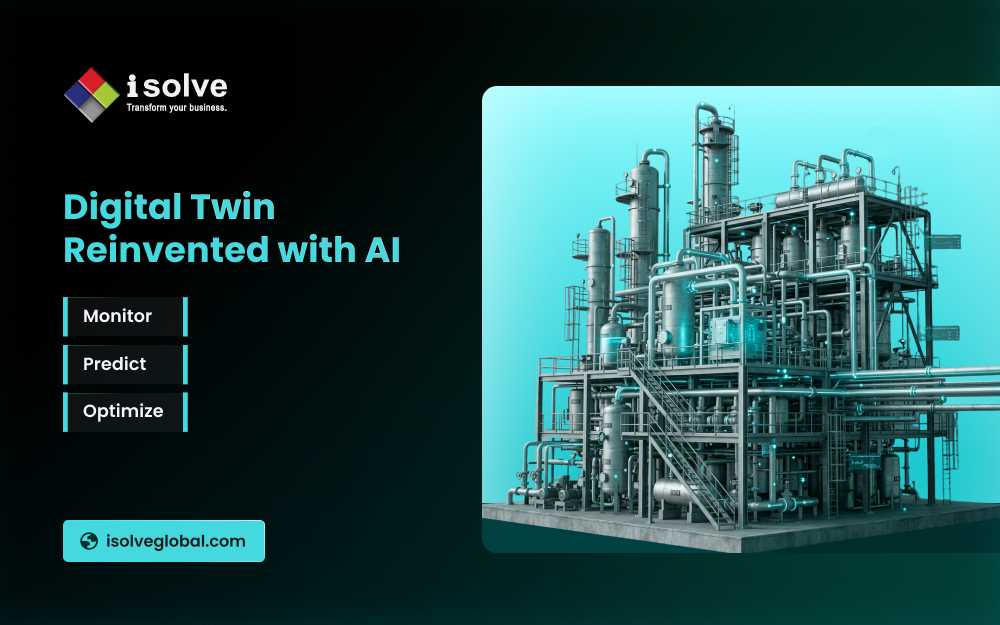
Welcome to Digital Twin 2.0—where Artificial Intelligence (AI), Machine Learning (ML), and advanced analytics transform static digital representations into intelligent decision-making systems.
At iSolve Engineering Technologies, we are helping engineering, EPC, manufacturing, energy, and process industry organizations unlock the next generation of plant performance through AI-powered Digital Twin solutions that enhance efficiency, predict failures, optimize resources, and automate lifecycle management.
The result?
Smarter facilities. Lower operational costs. Increased asset reliability. And data-driven decision-making across the entire plant lifecycle.
What is Digital Twin 2.0?
A traditional digital twin creates a virtual replica of a physical asset, plant, or process.
Digital Twin 2.0 goes far beyond visualization.
It combines:
- Real-time operational data
- AI-driven analytics
- Machine Learning algorithms
- Predictive intelligence
- Automated recommendations
- Continuous performance optimization
Instead of simply showing what is happening inside a facility, Digital Twin AI predicts what will happen next and recommends the best course of action.
This transforms digital twins from passive monitoring tools into intelligent operational advisors.
Why Traditional Plant Lifecycle Management Needs an Upgrade
Industrial facilities face increasing challenges:
- Aging infrastructure
- Rising maintenance costs
- Unplanned downtime
- Resource inefficiencies
- Data silos across departments
- Increasing sustainability requirements
- Shortage of experienced plant personnel
Conventional maintenance strategies often react to failures after they occur.
By then, the cost impact is already significant.
According to multiple industry studies, unplanned downtime can cost industrial organizations millions of dollars annually while reducing productivity and asset utilization.
This is where Plant Lifecycle Automation powered by AI becomes a game changer.
How AI Enhances Digital Twin Technology
Artificial Intelligence serves as the intelligence engine behind Digital Twin 2.0.
By continuously analyzing operational data streams from sensors, engineering models, equipment histories, maintenance records, and production systems, AI can identify patterns that humans often miss.
Key AI Capabilities Within Digital Twins
1. Predictive Maintenance
One of the most impactful applications of Digital Twin AI is predictive maintenance.
Machine learning models continuously monitor:
- Equipment vibration
- Temperature fluctuations
- Pressure variations
- Operational performance
- Historical maintenance records
The system can detect anomalies before failures occur.
Instead of replacing components on fixed schedules, maintenance teams can intervene precisely when needed.
Benefits include:
- Reduced downtime
- Lower maintenance costs
- Extended equipment lifespan
- Improved reliability
For EPC operators and industrial facilities, this creates a significant competitive advantage.
2. Intelligent Asset Optimization
Every plant asset performs differently under varying operational conditions.
AI-enabled digital twins continuously evaluate:
- Equipment efficiency
- Energy consumption
- Production throughput
- Process bottlenecks
- Resource utilization
The system can recommend operational adjustments that maximize performance while minimizing costs.
This level of optimization was previously impossible using traditional monitoring systems.
3. Automated Root Cause Analysis
When operational issues occur, identifying the root cause often requires hours—or even days—of investigation.
Digital Twin AI can instantly analyze interconnected systems and identify the probable source of a problem.
This dramatically reduces troubleshooting time and helps maintenance teams take corrective actions faster.
EPC Predictive AI: Transforming Engineering and Construction Projects
Engineering, Procurement, and Construction (EPC) projects generate massive volumes of design, construction, commissioning, and operational data.
Traditionally, much of this valuable information becomes underutilized after project handover.
With EPC Predictive AI, digital twins continuously leverage project data throughout the plant lifecycle.
At iSolve Engineering Technologies, our expertise in:
- Smart BIM Solutions
- Intelligent BIM (iBIM) Level Management
- 3D Plant Engineering
- Smart Schedule Builder
- Digital Engineering Workflows
creates the ideal foundation for AI-powered digital twins.
This enables organizations to:
Predict Construction Risks
AI can analyze project schedules, engineering dependencies, and historical project data to identify potential delays before they impact execution.
Optimize Resource Allocation
Machine learning algorithms help forecast workforce requirements, equipment utilization, and procurement schedules.
Improve Commissioning Readiness
Digital twins validate systems virtually before physical startup, reducing commissioning challenges and accelerating project delivery.
Real-Time Operational Intelligence Through Connected Data
The true power of Digital Twin 2.0 emerges when multiple data sources converge into a single intelligent ecosystem.
Integrated platforms can combine:
- BIM models
- Plant engineering data
- SCADA systems
- IoT sensor data
- ERP systems
- Asset management platforms
- Maintenance records
AI continuously processes this information to create a real-time operational picture.
Plant managers gain immediate visibility into:
- Asset health
- Production efficiency
- Maintenance priorities
- Energy performance
- Safety risks
- Sustainability metrics
This supports faster and more informed decision-making.
The Role of Smart BIM in Digital Twin Success
A digital twin is only as valuable as the quality of its underlying engineering data.
This is why Smart BIM and intelligent plant engineering play a critical role.
At iSolve Engineering Technologies, our Smart BIM framework provides:
- Accurate digital asset representation
- Centralized engineering information
- Enhanced collaboration
- Data-rich models
- Lifecycle traceability
These BIM-enabled digital foundations become the backbone of AI-powered digital twin ecosystems.
When engineering models remain synchronized with operational data, organizations achieve a true “living model” of their facilities.
Data-Driven Sustainability and Energy Optimization
Sustainability goals are becoming increasingly important across industrial sectors.
Digital Twin AI supports environmental initiatives by:
- Monitoring energy consumption
- Detecting inefficiencies
- Optimizing equipment performance
- Reducing carbon emissions
- Improving resource utilization
Machine learning algorithms can identify hidden opportunities for energy savings while maintaining production performance.
This creates both environmental and financial benefits.
The Future: Autonomous Plants Powered by AI
Digital Twin 2.0 is only the beginning.
The next phase of industrial transformation will involve:
- Self-learning systems
- Autonomous maintenance planning
- AI-assisted engineering decisions
- Real-time risk prediction
- Automated operational optimization
- Generative engineering simulations
Future facilities will not simply react to events.
They will predict, adapt, and optimize themselves continuously.
Organizations that invest in Digital Twin AI today will be positioned to lead the next generation of industrial innovation.
How iSolve Engineering Technologies Enables Digital Twin Transformation
At iSolve Engineering Technologies, we combine deep expertise in:
- 3D Plant Engineering
- Smart BIM Solutions
- Intelligent BIM Level Management
- Engineering Data Integration
- Smart Schedule Automation
- Plant Digitization
- Digital Engineering Services
to help organizations build scalable Digital Twin ecosystems.
Our approach focuses on creating intelligent digital environments that connect engineering, construction, operations, and maintenance into a single source of truth.
The result is enhanced visibility, predictive intelligence, and lifecycle-wide operational excellence.
Conclusion
The evolution from traditional digital twins to Digital Twin 2.0 marks one of the most significant advancements in industrial digital transformation.
By integrating AI, machine learning, predictive analytics, and connected engineering data, organizations can move beyond monitoring toward intelligent automation and proactive decision-making.
From predictive maintenance and asset optimization to EPC predictive AI and plant lifecycle automation, Digital Twin AI is redefining how industrial facilities are designed, operated, and optimized.
As industries embrace smarter, more connected operations, organizations that leverage AI-powered digital twins will gain a decisive advantage in efficiency, reliability, sustainability, and long-term asset performance.
At iSolve Engineering Technologies, we are helping engineering and industrial organizations transform plant lifecycle management into a predictive, intelligent, and future-ready operation.


